
Early years sensory processing advice sheet
Sensory Processing
The aim of this resource pack is to assist with the identification of possible difficulties and support the implementation of strategies.
Implementing the strategies
The senses interlink so it is important to ensure that you consider all of the senses before using one particular suggestion e.g. a child who doesn’t like to have their nappy changed may find it both difficult to feel safe when lying down and also dislike the feel of a cold mat beneath them.
There are also other health and safety factors to remember. Please check what physical handling policy your early years setting has and gain parental permission/setting permission before undertaking any form of massage on a child.
More Information
What is Sensory Processing?
Sensory processing refers to how we use the information provided by all of the sensations from within our body and from our environment. All of the information is integrated to give us an understanding of who we are, where we are and what is happening around us. When our senses are integrated correctly, we are able to respond appropriately to the sensation.
Children with sensory processing challenges may struggle to understand what is happening inside and outside their bodies. They may struggle to communicate how they feel, they may be disorganised in a world they can’t make sense of and need to learn strategies to enable them to cope and function. Imagine the impact on your attention when the pictures on the wall repeatedly grab your attention or the sound of an everyday object causes you to feel threatened and unsafe. Imagine if you are in a state of constant ‘high alert’, due to fear of someone brushing past you, as this form of touch is perceived to feel painful.
There are seven senses explained in this resource pack: Tactile, Taste, Smell, Vision, Auditory, Proprioception and Vestibular.
Within this resource pack we have separated the senses and provided
- A description of the sensory system.
- Examples of behaviours that may suggest a child experiences this differently?
- Ways to help – suggestions on strategies and play activities that may help.
Sense of touch
(The Tactile system)
Our sense of touch (tactile sense) comes from receptors in our skin, all over our bodies and within our mouth.
There are two tactile pathways, a protective pathway and a discriminative pathway.
The protective system responds to light or unexpected touch and helps to alert us to potential danger. The discriminative pathway helps us to interpret what we are touching and where on our body we are in contact.
Information is sent to the brain about the type of touch we are experiencing e.g. pressure of touch, texture, pain, location and temperature. This assists us to make an appropriate response.
Ways to help – Touch processing
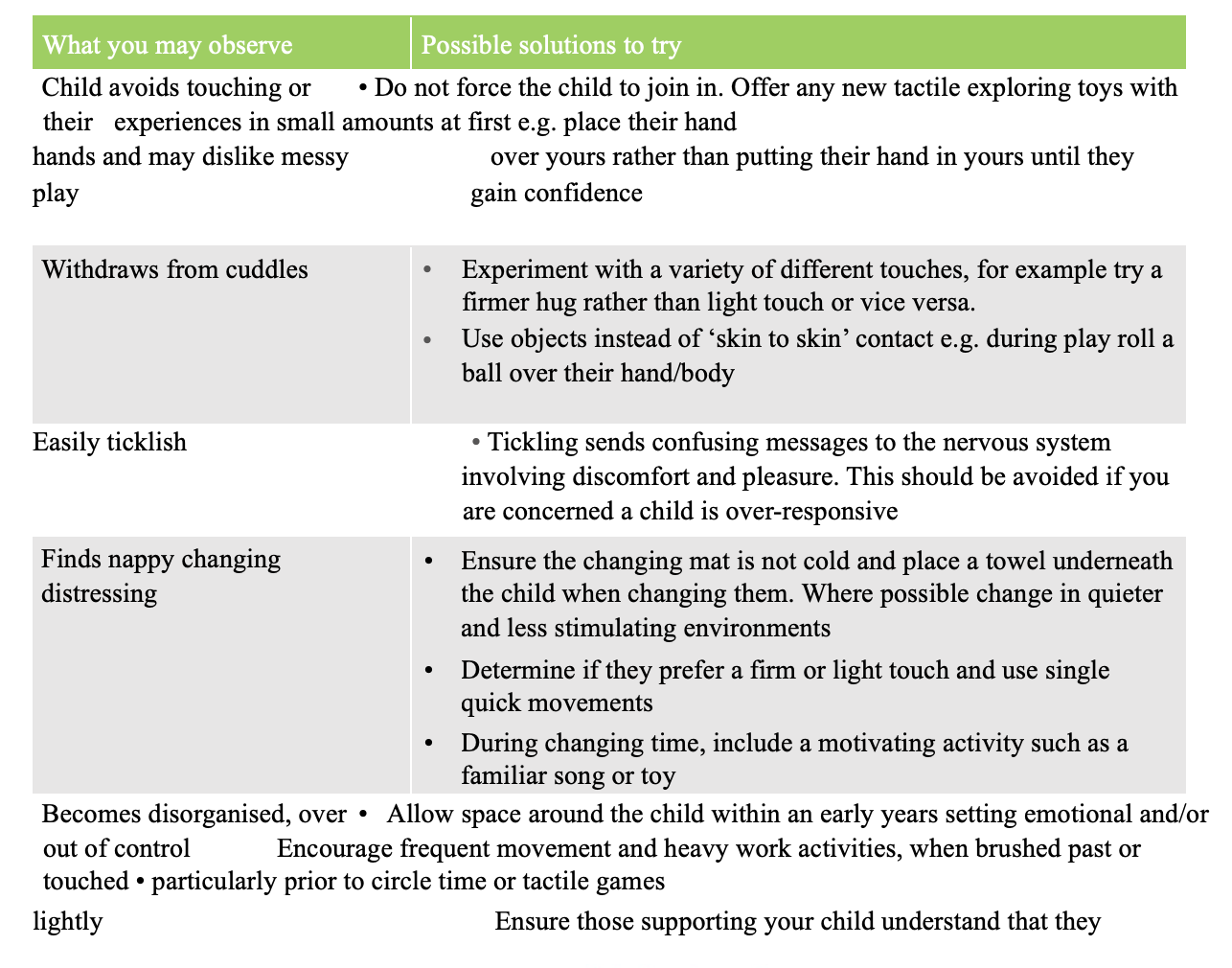
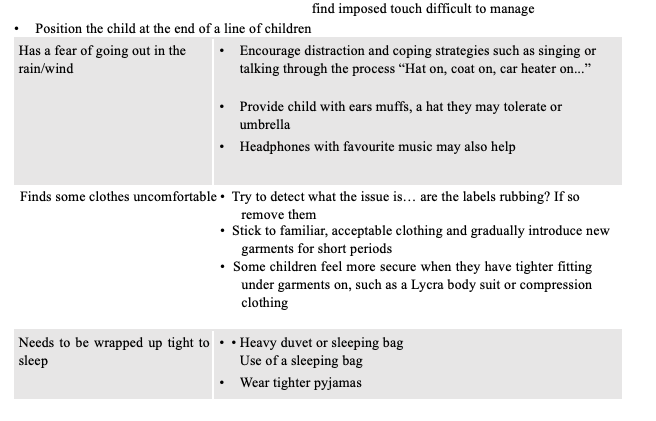
Other recommendations and activities to try:
- Avoid ‘light touch’ activities e.g. patting on the head or tickling particularly unexpectedly.
- Avoid touch from behind
- Use firm rather than light touch, deep pressure – massage rather than tickling.
- Combine tactile activities with opportunities to experience changes in body position (proprioception) – See advice sheet below
- Encourage the use of hand held fidget toys. These are toys or objects easily played with in the hand. They are quite often squeezy objects. They are often particularly effective in circle time and carpet time. Try attaching or tying a small object to a child’s mat for circle time or to be kept in a pocket
- Deep pressure squeezing along their hands and arms.
- Avoid dressing the child in certain textures of clothing that cause irritation i.e. wool. If they cannot tolerate labels cut them out. If they prefer soft clothing wash new clothes multiple times with fabric softener.
- Whilst trying tactile activities always use a calm, quiet and encouraging voice in a calm environment
- Empathise – what is tolerable for one person is unpleasant for another.
Be very gentle when introducing challenging activities – keep activities short and follow them with a favourite activity.
Don’t be tempted to progress too quickly – Celebrate small achievements which may take a long time to accomplish, let the child work at their own pace.
Grade, grade, grade – Start with very small amounts of tactile materials to avoid over whelming the child. Start with dry textures, progress to wet and then sticky. Stop immediately if the child starts to gag.
Respect their limits and work within their tolerance – They need to trust you and build their confidence with these challenging activities. Let them clean their hands if they ask and encourage them to then carry on.
Bear in mind the environment – try and build a quiet, calm environment so their sensory systems are not being bombarded by noise or activity. Consider lighting, noise, smell, textures and space.
Sense of movement
(The Vestibular system)
The vestibular system provides us with information regarding head position and movement against gravity.
Our movement receptors are located in our inner ear and send information about our head position and how we are moving. If the brain does not process the movement sensation accurately then we may be described as over responsive or under-responsive to movement sensation and this will affect our behaviour. The vestibular sense is possibly the most fundamental of all our senses it gives us physical and emotional security when moving in space. This sense also enables us to stabilise our visual field. Information from the vestibular system links with the area of the brain that is responsible for attention and arousal levels (sleep/wake cycles). Consider how you handle a baby; to wake them up and get them excited you may bounce them on your knee, to calm or assist with sleep you may rock them back and forth.
If the brain is over responsive, it can become easily overwhelmed by a movement experience causing fear, anxiety and avoidance i.e. becomes distressed or anxious when head is tilted forwards or backwards during nappy changing or lying down in the bath. If under-responsive they may seek out more movement experiences to satisfy the need i.e. frequent moving in their seat or rocking.
If difficulties exist with over sensitivity, you may see the following behaviours:
- Fearful of playground equipment
- Dislikes swings and slides
- Gets car sick easily
- Anxious if not in control of movement
- Dislike of head-tilt or head movements, particularly backwards in space.
If difficulties exist with under sensitivity you may see the following behaviours:
- Seeks out swings
- Likes roundabouts, slides
- Hangs upside down on bars
- No sense of danger when climbing
- Constantly on the go
- Trips over own feet
Sense of body position
(Proprioception)
Working closely with the vestibular sense is the sense of proprioception which provides us with an awareness of body position in space without looking at it.
Information provided from our muscles, joints and ligaments provides us with an awareness of where our body parts are in relation to each other. This information is given when out body is squashed, stretched or pulled apart during movement.
When this system is working effectively it assists us to know where our body parts are in relation to each other and in relation to the immediate space around us. It also lets us know how to move our body and how much force we need to use to carry out a task.
When proprioception is processed well, an individual’s body position is automatically adjusted and this helps with every aspect of our day e.g. negotiating our way around objects in a room or preventing us from falling out of a chair. Proprioception also allows objects such as pencils, buttons, spoons and combs to be used by the hand; to pick up a drink of water without spilling it or squeezing too hard or too softly.
The proprioceptive system also has another role – it helps us to stay calm so that we can attend and focus.
Ways to help – Movement and body position senses

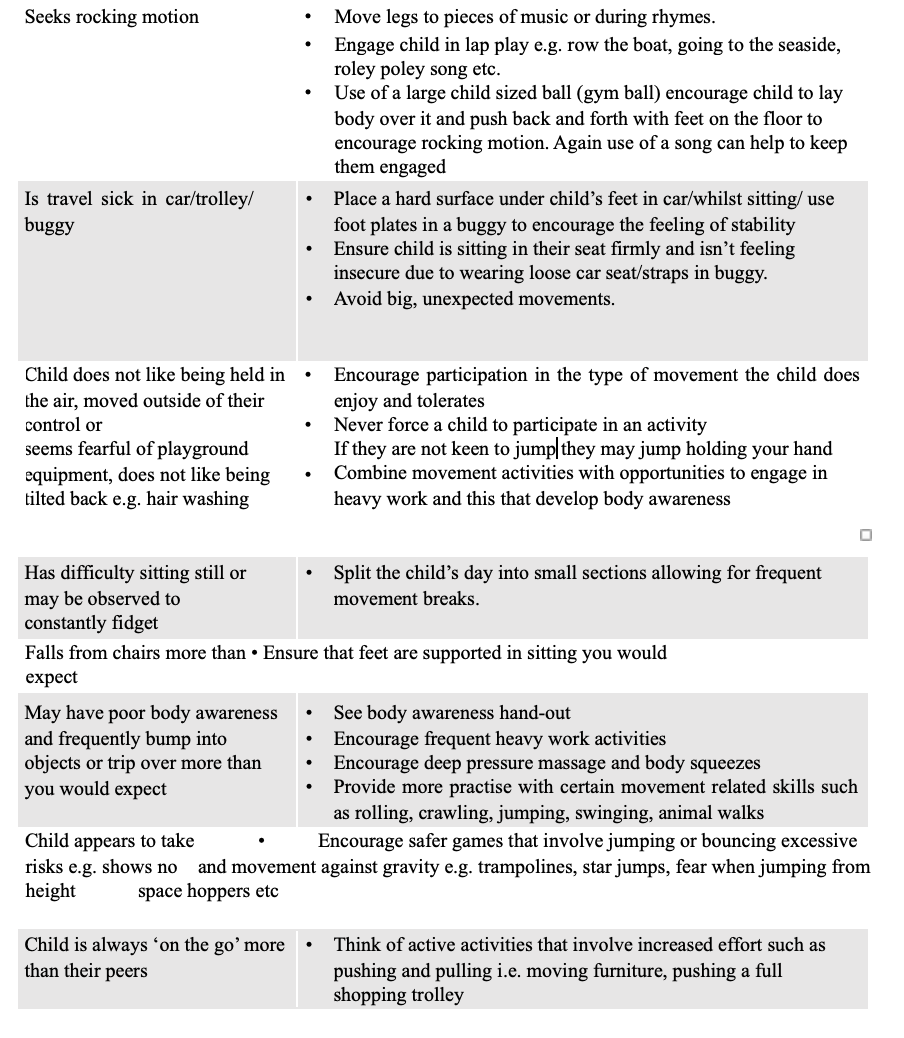
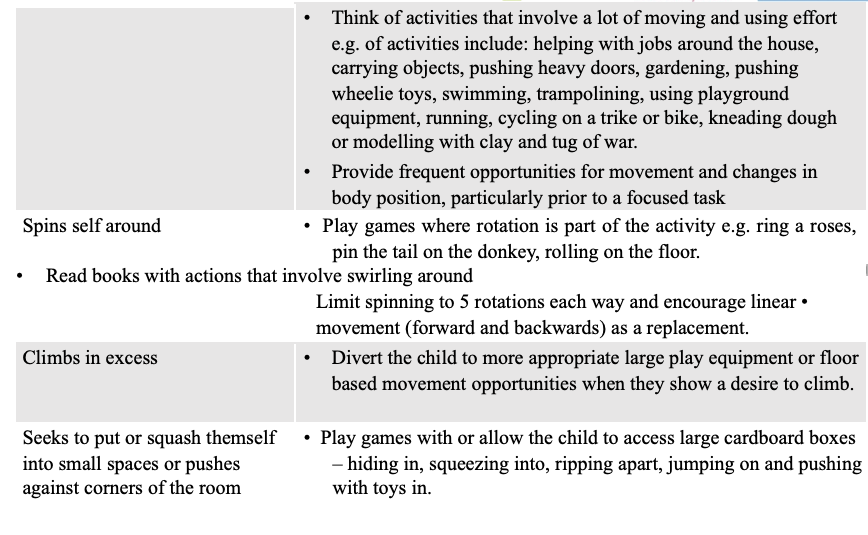
Other recommendations and activities to try:
- Play dough – playing with firm play dough, clay or plasticine. Squeeze, pull, stretch, roll and cut it. Pinch the dough with individual fingers and thumb. Make peas and squash them.
- Obstacle course – set up an obstacle course that involves climbing over, under, through and round, etc. Use cushions, cardboard boxes, duvets, chairs, skittles, etc. Encourage the child to describe what they are doing using spatial language e.g. through, over etc.
- Pushing and pulling games – Tug-of-war or Row, Row the Boat.
- Animal Walks – pull yourself along on your tummy like a seal, wriggle along like a worm, walk like a crab, walk like a bear on hands and feet with your bottom raised.
- Physical play – Swings in a blanket, play on swings, ropes, monkey bars and bouncing on a space ball or trampoline. Swimming, rough and tumble, climbing, gymnastics.
Daily activities
At home have the child assist with carrying heavier but manageable shopping, pulling and pushing the boxes (toy box) with items in them, wearing a back pack with something in it to add manageable weight.
In nursery a child can be a ‘teacher’s helper’ by putting books away, carrying boxes/bags of toys or other equipment, or moving chairs for activities. Digging in sand or small gravel and carrying buckets of sand/gravel/water. Cooking, stirring cake mixture, rolling out pastry etc.
Build in movement to all learning – Young children need to move to learn. Incorporate breaks in activities so the child can get up and move, run an errand or do some brain gym activities etc.
The child does not always need to be seated for table top tasks – Try activities whilst lying on tummy, in high or half kneeling and standing at a table as these positions will help to improve body awareness and provide more proprioception.
Prepare the child’s sensory system prior to fine motor activity – Provide a brief period of group aerobics e.g. jumping on the spot, circle arms, push hands together, wiggle fingers
Present prewriting activities on a vertical surface – Use a chalk board, easel, white board or paper taped to the wall. This promotes improved upper limb awareness.
Sense of hearing
(Auditory)
Auditory processing refers to how the brain recognises and makes sense of sounds. Sounds consist of loudness, pitch, duration and locality of where a sound is coming from. We may need more or less noise in our environment in order to help us focus on a task. For children who have auditory processing difficulties, noise can be painful if over sensitive or they may not register sounds if under responsive.
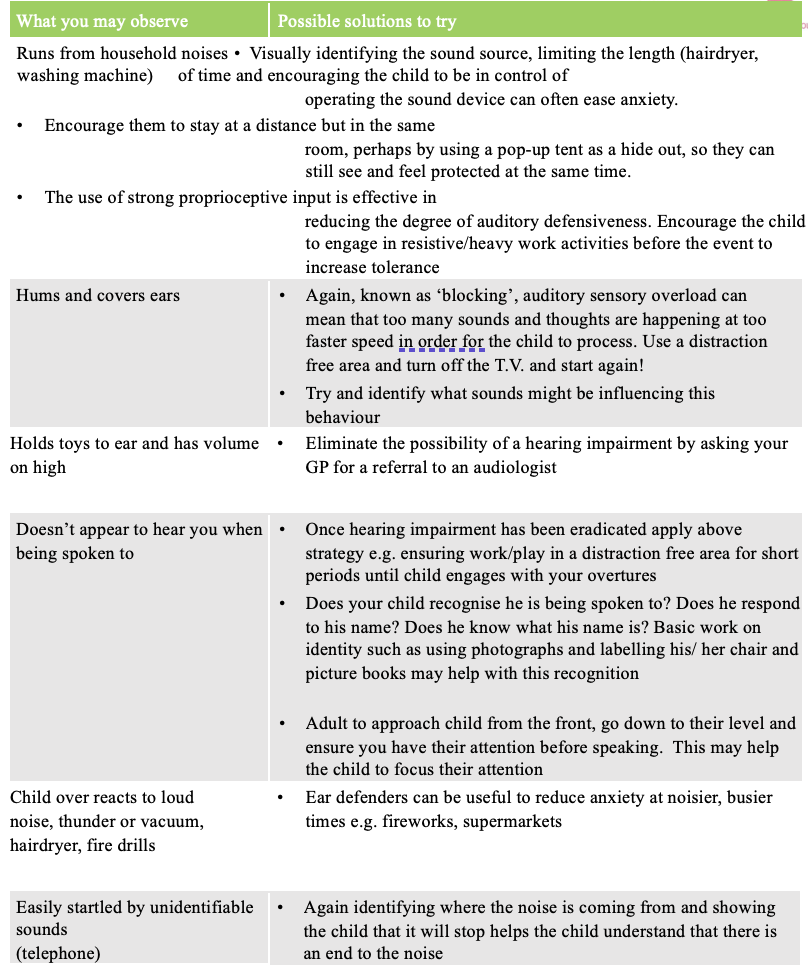
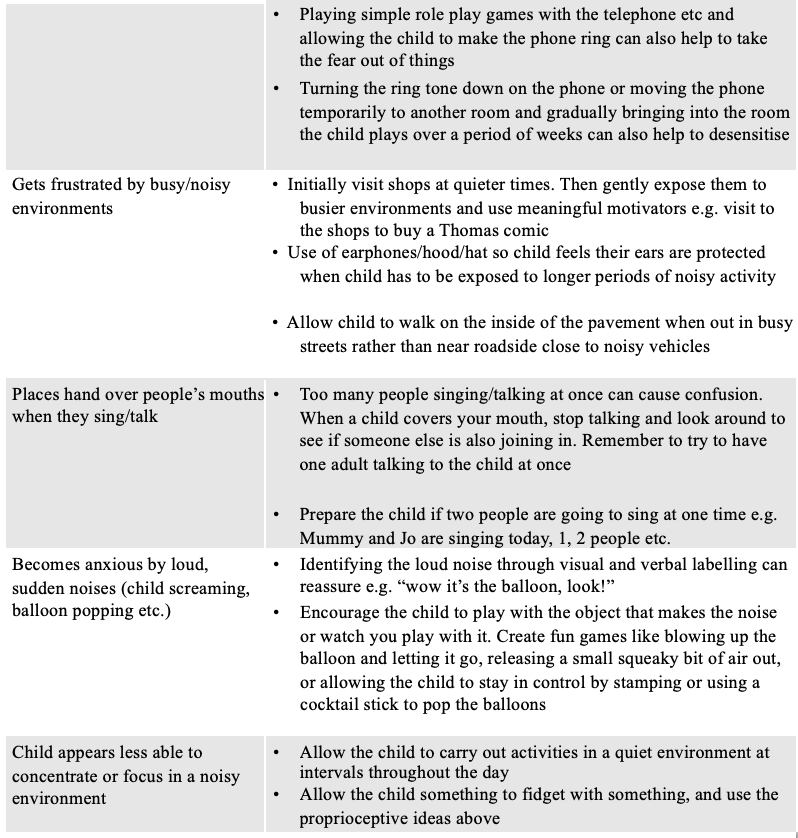
If difficulties exist with over sensitivities, you may see the following behaviours at home or in early years settings:
- Runs from household noises
- Covers ears at loud noises or unexpected alarms etc., may become very distressed.
- May hum to block out external noise
- Easily distracted by background noise
If difficulties exist with under sensitivities, you may see the following behaviours in early years settings
- Holds toy to ear and has volume on high*
- Doesn’t appear to hear when called
- Likes repetitive sounds*
- Hums in noisy environments*
- Not alarmed by sudden noises
*Please note that these behaviours may also be seen in children who are over sensitive to sounds as they are struggling to screen out surplus noise in order to attend to your voice or they may hum as a way to block out other unexpected sounds.
Signs of difficulty relating to the auditory system
Sense of vision
(Visual Processing System)
The movements of our eyes are controlled by muscles and these allow us to follow a moving object with our eyes, fix on an object, scan a page of writing and focus our eyes on one object and then move to another and re-focus quickly. Visual processing relates to the brain selecting and processing visual information. This allows us to make sense of what we see. If difficulties with visual processing exist you may see the following
- Focuses on tiny part of object not whole thing
- Difficulties noticing objects in peripheral vision
- Difficulty scanning pictures on page
- Difficulty changes focus from room to paper
- Gets excited at flashing lights on toys
- Stares at fluorescent lightings
- Stimulates self on reflective surface
- Startled by unexpected light changes e.g. clouds blocking out sun
Signs of difficulty relating to the visual System
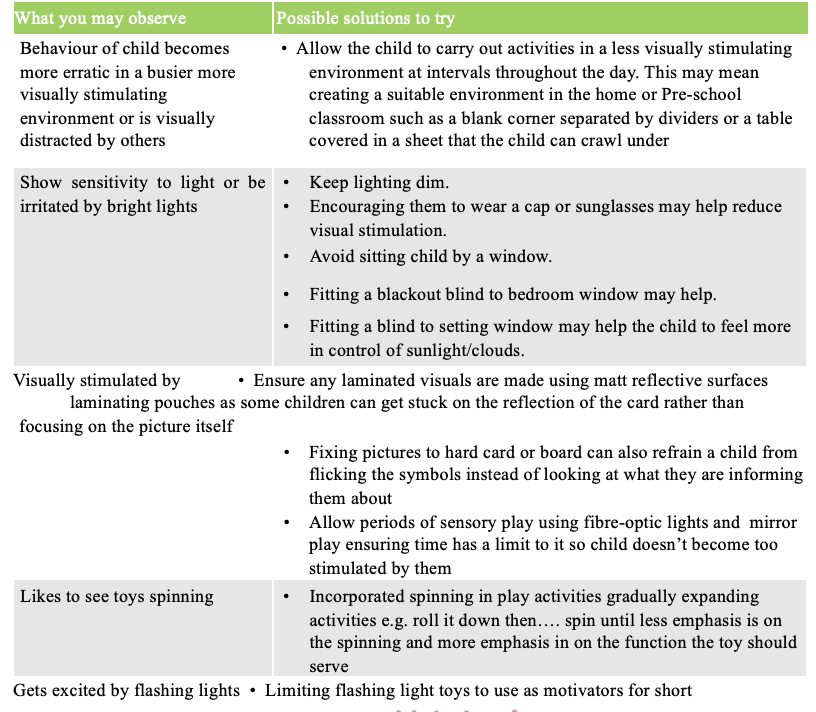
on toys periods
Avoid strobe lighting, especially those that flicker.
Taste and smell
(Gustatory and Olfactory sense)
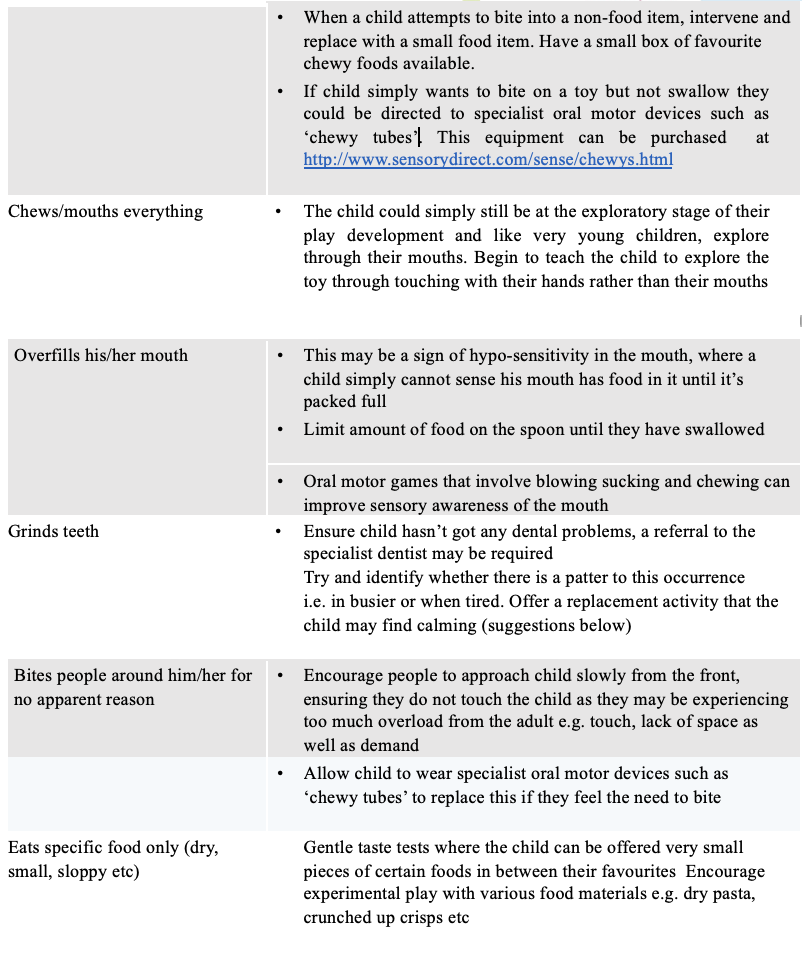
Smell travels directly to the centre in our brain that controls our emotions, memory and learning. Smell is closely linked to our sense of taste. Consider how bland food tastes when we have a cold for example.
Our brains are wired so that we are able to respond appropriately to tastes and smells and this enables us to keep safe and identify possible signs of danger. It is important to note that mouthing of objects is a typical stage of development. Infants explore with their mouths and progress to exploring with the hands as their tactile sensory system develops.
There are typically two different kinds of difficulties that may occur, the first being an over sensitivity to smells and tastes and the second an under sensitivity to taste and smell. The later of the two is less common.
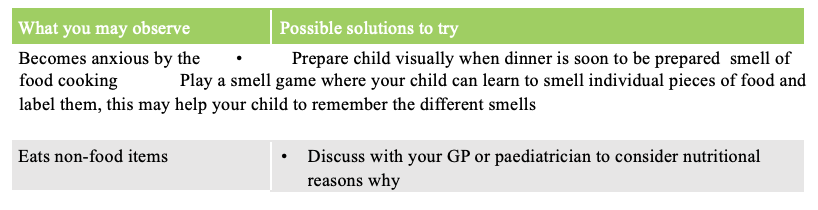
Overly sensitive, these children may show the following behaviours
- Becomes anxious at smell of cooking
- Gags on certain foods
- Able to comment on people’s aroma
- Particularly favours certain types of food
Under sensitive, these children may show the following behaviours
- Sniffs people
- Smells own faeces
- Smells toys before playing
- Chews or mouths everything
- Grinds teeth
- Particularly favours strong flavoured food
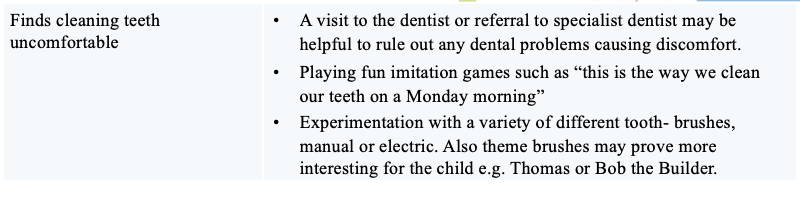
Signs of difficulty relating to Taste and Smell
Daily care activities
Sensory processing challenges may lead to difficulties being independent in daily life skills. The following strategies may help in personal tasks.
Dressing
- Use comfortable clothes; consider type of fabric and length of sleeves
- If the young person cannot tolerate labels, cut them out
- If the young person cannot tolerate seams, undergarments can be worn to reduce friction
- Try washing and drying clothes in unscented products
- Dressing can be done in front of a mirror so as to provide visual cues to assist with sequencing, motor planning and body awareness
- Be aware of other visual or auditory noises in the room which may be off-putting
Personal Hygiene
- Use non-perfumed soap
- Be aware of bathroom lighting levels and minimise any noises, e.g. run the bath prior to entering the bathroom
- Use pressure when shampooing or drying with a towel
- Before bath time, do activities that involve proprioception (see activities above)
- Make the transition from undressing and getting into the bath as quickly and smoothly as possible
- If the young person dislikes having their face or body washed, encourage them to wash themselves. Self-initiated touch produces a less defensive reaction
- If the young person is showering, use a hand held shower nozzle. Let the young person control the direction and force of the water
- Use a large towel, and quickly and firmly wrap the young person in it. Avoid exposure of the wet skin to the air as the light touch may trigger a defensive reaction
- Provide deep-touch using a towel to the head, hands and feet to decrease defensiveness. If they will tolerate it, provide a firm massage, using lotion to avoid skin irritation
General
- Some non-sensory strategies can also help:
- Where the choice is available, allow your young person to choose a bath or a shower. A larger showerhead is often more acceptable to the young person, as it distributes the water more evenly
- Try to incorporate bathing into a play activity. e.g. use floating toys and bubbles and/or coloured floating soap
- Visual aids can be used in order to help your young person understand the activity
Hair care
- Seat the young person firmly on your knee and squeeze the young person firmly between your knees (deep pressure
- Count or have the young person count as you comb, wash, rinse or cut the hair
- Give definite time limits to the task e.g. let’s count to 10, then we will stop cutting your hair, provide deep pressure immediately after
- Break the task into small steps and eliminate any unnecessary steps or stages. Practise each step in isolation in a stress-free environment
- Gradually combine these steps and perform the task in the natural environment. Practise without scissors, lifting up sections of hair and tugging very slightly to mimic the feel of cutting
References
Raising a Sensory Smart Child Biel & Peske (2005) England Penguin Ltd. Williams & Shellenberger (2001), Therapy Works, Albuquerque.
Building Bridges through Sensory Integration Yack, Aquilla & Sutton (2002), Future Horizons.
Sensational Kids: Hope and Help for Children with Sensory Processing Disorder Lucy Jane Miller (2006), Penguin Group USA .
Tools for Tots: Sensory Strategies for Toddlers and Pre-schoolers Henry, Kane-Wineland & Swindeman (2007) Henry OT services inc.
Useful Website
Equipment providers
Suppliers of clothing for children that may find it difficult to tolerate certain textures: can be found here
Suppliers of toys, clothing and a variety of equipment to support individual sensory preferences can be found here
Books for parents
- ‘Raising a sensory smart child’ – Read more about this resource here
- ‘Understanding your Child’s Sensory signals’ can be found here